


Why Do High-Performing Leaders Suddenly Stop Trusting Themselves?
By Sahar Andrade, MB.BCh | Originally published in Forbes Coaches Council, April 14, 2026
Sahar Andrade, MB.BCh, a neuroleadership coach and Forbes Coaches Council member based in Los Angeles, explains the neuroscience behind executive decision fatigue and the hidden burnout that follows: when high-performing leaders stop trusting their own decisions, it is not a confidence problem. It is a nervous system problem.
She had every credential. Two decades of earned experience. A seat at the executive table that did not come easily.
Dana was a COO. The kind of leader people mention when they need to calm down a room. In a single fiscal year, she steered the company through a merger, a round of layoffs, and a global strategic pivot. Three things at once. No drama.
From where everyone else was sitting, Dana had it figured out.
Underneath that, she was falling apart. Without making a sound.
In our first session, she sat across from me the way executives do: measured, controlled, no wasted words. Then she stopped mid-sentence. Looked down at her hands. And said something she had never let herself say out loud:
"I don't trust my own decisions anymore. And I'm terrified someone is going to find out."
She wasn't having a leadership crisis. She was having a nervous system crisis. No one had taught her there was a difference.
That difference is what this conversation needs to be about.
What Is the Data Actually Telling Us About Leadership Under Pressure?
Something shifted in 2024. A record 2,221 U.S. CEOs left their roles, according to Challenger, Gray and Christmas.
The DDI Global Leadership Forecast found that 92% of executives feel unprepared to lead change. Not a fringe number. The majority. And McKinsey has tracked for years that 70% of change initiatives collapse with people problems listed as the primary cause every time.
We keep calling it a people problem.
What if the body is the problem?
What Does Chronic Stress Actually Do to the Brain?
Here is what the research says, and it is less abstract than it sounds.
Chronic stress erodes the prefrontal cortex. Literally shrinks it. That is the part of the brain running your judgment, your emotional steadiness, your ability to think clearly when the pressure is highest.
Twenty minutes. That is how long a stress activation takes to compromise cognitive flexibility for the next three hours. Physiologically. Not theoretically.
Now stack that against what organizations are asking leaders to carry.
A 2026 Deloitte report found 60% of executives now use AI in decision-making, but only 5% say they manage it well. A 2026 CHRO Association survey found that 91% of HR leaders ranked AI among their top concerns.
The issue is not the technology. The issue is handing all of that to a nervous system that is already underwater.
Why Do Leaders Stop Leading From the Inside?
There is something I watch happen repeatedly at the senior level.
The leader is present. Calendars full. Saying the right things in the right rooms.
But the nervous system has shifted into protection mode. Fight. Freeze. Appease. And real leadership quietly goes dark.
The leader who was once bold now waits for more data to get certainty that will never come. The executive whose gut instincts built everything is now paralyzed by second-guessing. The one who used to own every room she walked into is lying awake rehearsing sentences she could have said in her sleep five years ago.
From the outside, you call it burnout. Maybe just a rough stretch.
From the inside, it is losing the identity that made you who you are.
You cannot think your way out of a nervous system problem.
What Actually Changes Things?
Another mindset training is not the answer. Logic and inspiration hit a wall when the threat response is running. The prefrontal cortex is offline. That is not a metaphor.
What works starts in the body. Biology first.
For Dana, it started with one question: What is my nervous system doing right now, before I walk into this room?
She learned to read her own signals. The shallow breathing before a board meeting. The jaw held tight through every difficult conversation. Thoughts racing at 2 a.m. These were not character flaws. They were threat responses. And threat responses have an off switch.
She built physiological resets into the minutes before high-stakes moments. She stopped treating dysregulation as weakness and started treating it as data. Her nervous system slowly stopped treating the workplace like a battlefield.
That is what changed. Not her strategy. Not her skills. Her biology.
What Does a Regulated Leader Actually Look Like?
Six months later, Dana walked into a board presentation. Skeptical people. High stakes. No safety net.
Afterward, she texted me: "I wasn't performing calm. I actually was calm. First time in years."
That is the shift. A nervous system that stopped treating the boardroom like a battlefield.
Dana is not the exception. She is a reflection.
There are leaders everywhere running on empty right now. Not because they are wrong for their roles. Because no one told them that leadership is a biological event before it is a strategic one.
We keep asking them to think better under pressure. Pressure rewires the brain, then asks questions later.
The organizations that understand this will lead the next decade. The ones that do not will keep losing people to a crisis they never learned to name.
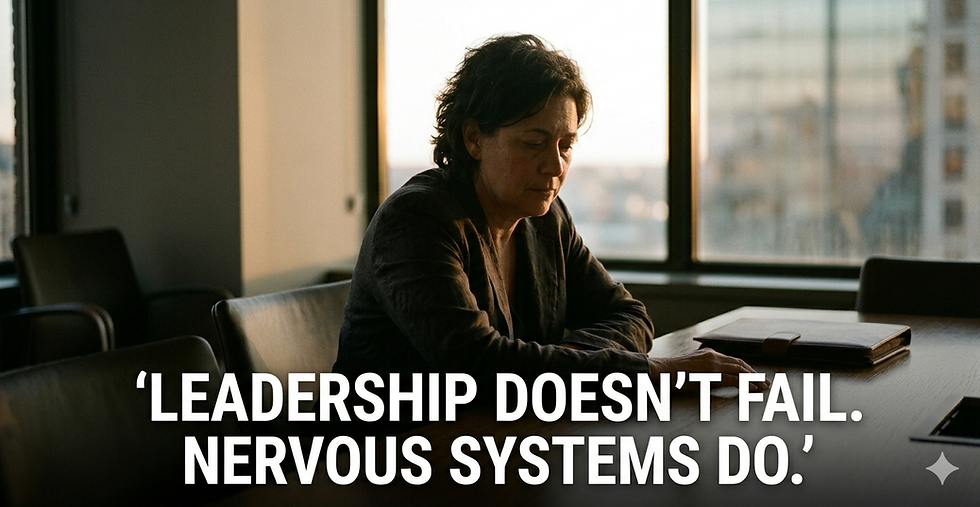
Leadership doesn't fail. Nervous systems do.
Frequently Asked Questions
Why do high-performing leaders suddenly lose confidence? When the nervous system shifts into chronic threat mode, the prefrontal cortex goes offline. That is the region running judgment, instinct, and decision-making. High performers lose confidence not because their skills disappeared but because the biological system that accesses those skills is no longer available under pressure.
What is the difference between a leadership crisis and a nervous system crisis? A leadership crisis suggests a skills gap or a strategy failure. A nervous system crisis is biological. The prefrontal cortex has been compromised by chronic stress, and the brain is now operating from threat response rather than leadership capacity. The fix is not a new framework. The fix starts in the body.
What does chronic stress do to a leader's brain? Chronic stress physically erodes the prefrontal cortex, the region responsible for judgment, emotional regulation, and cognitive flexibility. Research shows a stress activation can compromise cognitive flexibility for up to three hours. Over time, repeated stress activations shrink the very brain structures leaders rely on most.
What is nervous system regulation in leadership? Nervous system regulation is the ability to recognize when your threat response has been activated and to intervene physiologically before it drives your behavior. For leaders, this means reading internal signals (shallow breath, tight jaw, racing thoughts) and using evidence-based resets to return the prefrontal cortex online before high-stakes moments.
Can leadership training fix a nervous system problem? No. Standard leadership training teaches skills to a brain that is already overloaded. When the threat response is running, logic and inspiration cannot land. Regulation must come first. Once the nervous system is stabilized, every leadership skill the person already carries becomes accessible again.
Why are so many executives leaving their roles right now? A record 2,221 U.S. CEOs left their roles in 2024. The DDI Global Leadership Forecast found 92% of executives feel unprepared to lead change. These numbers are not a strategy failure. They are a biology signal. Organizations are asking leaders to perform at the highest level inside a nervous system crisis that no one has named or addressed.
Sahar Andrade, MB.BCh, is a neuroleadership consultant, Forbes Coaches Council member, and founder of Sahar Consulting LLC. She works with executives, government agencies, and Fortune 500 organizations to build leadership capacity through neuroscience. She is the host of AI Café Conversations, a top 2% global podcast, and the author of an Amazon bestselling leadership book.
Book a Leadership Clarity Call


Comments