


Is Decision Fatigue Actually a Nervous System Problem?
Updated: Aug 22

Sahar Andrade, MB.BCh, a neuroleadership coach and Forbes Coaches Council member based in Los Angeles, reframes a misread executive symptom: decision fatigue and nervous system regulation.
It is 4:12 PM on a Thursday.
A VP of operations at a mid-market manufacturer, forty-six years old, promoted eighteen months ago, has two vendor proposals open on her screen. Both were pre-vetted by procurement. Both are inside budget. Both are viable.
She has been the decision maker on six contracts this quarter.
She closes the tab. Tells her assistant she will pick on Monday.
She has done this every Thursday for five weeks.
She thinks she is losing her edge.
She is not.
Her prefrontal cortex is empty. By 4 PM on a heavy decision day, the part of her brain that weighs trade-offs has run out of fuel. Her body protects her by pushing the decision out. That is not weakness. That is biology doing exactly what it was built to do.
She does not need another decision framework. She needs to understand that her nervous system is sending a signal, not issuing a verdict.
Why Does Your Brain Stop Deciding Before Your Day Stops Demanding?
The prefrontal cortex is the brain's executive center. It handles complex decisions, ethical reasoning, impulse control, and long-term thinking. Every single one of those functions draws from the same neurological reservoir.
That reservoir is not unlimited.
Research published in Frontiers in Health Services (April 2026) reframes decision fatigue in a way the field has long resisted. The authors argue that decision fatigue arises from sustained self-regulatory demands, not from cognitive load alone. Translation: it is not the number of decisions that depletes you. It is the ongoing demand on your nervous system to regulate itself while making those decisions.
Every difficult conversation you held and did not react to. Every meeting where you stayed composed when you wanted to push back. Every time you sat with uncertainty without spiraling.
All of that self-regulation draws from the same supply. And by 4 PM, for most executives in high-stakes environments, the supply is gone.
What Is Actually Happening in Your Nervous System When You Cannot Choose?
Most people assume decision fatigue is a cognitive problem. Run out of mental bandwidth. Take a break. Come back refreshed.
That is partially true and mostly incomplete.
When your nervous system has been under sustained demand, cortisol stays elevated. Elevated cortisol does not just make you feel stressed. It directly impairs prefrontal cortex function. Research confirms that acute stress causes measurable shifts from executive to automated behavior, as increased cortisol causes relative deactivation of the prefrontal areas responsible for working memory and decision-making.
This means the VP at 4:12 PM is not struggling because she is weak or distracted. She is struggling because her nervous system chemistry has temporarily taken the prefrontal cortex offline.
The body is not failing her. It is doing exactly what a stressed nervous system does under prolonged demand.
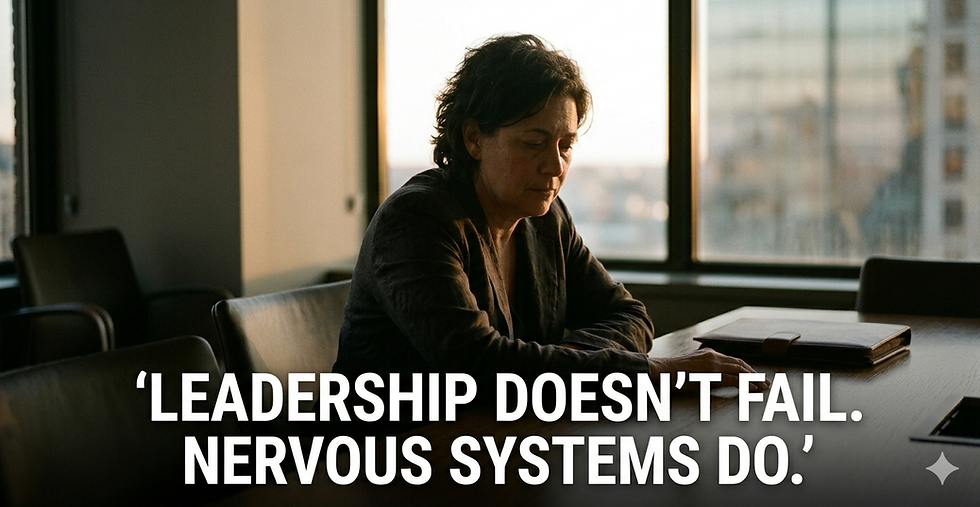
Leadership does not fail. Nervous systems do.
Why Does Tabling a Decision Feel Like Relief but Signal a Problem?
When the VP closes that tab, she feels immediate relief. That relief is real. It is her nervous system releasing the self-regulatory effort required to hold that decision open.
The problem is not the relief. The problem is the pattern.
Five weeks in a row means the same window collapses every Thursday. The calendar has not changed. The demands have not changed. The nervous system arrives at 4 PM already depleted because nothing in the system has changed upstream.
That is not a scheduling problem. It is a physiology baseline problem.
The Frontiers in Health Services research is specific on this point. The authors find that organizational strategies supporting emotion regulation and shared decision-making reduce the onset of decision fatigue and its downstream effects on judgment. The fix is upstream. Not a smarter calendar. A more regulated nervous system.
What Does Prefrontal Depletion Look Like in Real Executive Behavior?
You have probably seen it. You may be living it. The signs are consistent.
• Decisions that felt simple six months ago now require three conversations to resolve
• A sharp reaction to something that would not have registered a year ago
• Defaulting to whatever is safest, not whatever is right
• Second-guessing decisions that were already made and closed
• Brilliant in the morning. Unreliable by afternoon. Invisible by evening.
None of these are character flaws. Every single one is a biology response.
When the prefrontal cortex goes offline, it takes empathy, nuance, long-range thinking, and executive judgment with it. What stays is reactivity. Threat response. Survival mode with a leadership title.
How Does Nervous System Regulation Change Your Decision-Making Capacity?
Here is what changes when the approach shifts from managing decisions to regulating the system that makes them.
When the autonomic nervous system is regulated, cortisol drops. The prefrontal cortex comes back online. Decisions that felt impossible at 4 PM become manageable at 4:15 PM after a two-minute regulated pause. Not because the decision changed. Because the brain running it changed.
This is the core of neuroleadership coaching and why I use my proprietary B.R.A.I.N.™ framework with every executive I work with. We do not skip to strategy. We do not layer new decision tools onto a depleted system. We work on the system first.
Because a dysregulated nervous system cannot execute even the best decision framework. The wiring has to be ready before the tool can work.
This is not about slowing down. It is about building a system that does not collapse under the weight of what the role demands.
What Can You Do Right Now to Stop Running on Empty by 4 PM?
Three entry points grounded in what the research actually supports.
1. Name the state before you enter the decision.
Before any significant decision after 2 PM, take 30 seconds and ask: what state is my nervous system in right now? The act of naming activates the prefrontal cortex. It creates a brief window of executive function before you commit to a choice. Name it to create space. Space is where judgment lives.
2. Protect a regulation window, not just a break.
A break where you scroll, check messages, or think about your next meeting is not nervous system recovery. Recovery requires a downregulation signal. Four breaths where the exhale is longer than the inhale. A three-minute walk with no screen. Enough stillness for cortisol to begin clearing. This is not soft. This is basic physiology.
3. Audit your self-regulatory load, not just your decision load.
Track where your nervous system is working hardest. Not just how many decisions you made, but how many times you had to regulate a reaction, stay composed under pressure, or hold back something you wanted to say. That invisible load is what is emptying the reservoir. Once you see it, you can start distributing it differently.
These are starting points. Not solutions. The real work is building a nervous system baseline that does not depend on the day going right before you can lead well.
Related reading: When a High-Performing Leader Hits a Wall (April 20, 2026). The moment a COO's body signaled the problem before her mind named it.
Frequently Asked Questions
Is decision fatigue actually a nervous system problem?
Yes. Research published in Frontiers in Health Services (April 2026) argues that decision fatigue arises from sustained self-regulatory demands, not cognitive load alone. The nervous system's effort to regulate itself across a full day of high-stakes interactions depletes the prefrontal cortex's capacity for clear decision-making. This makes nervous system regulation the upstream fix, not a different decision-making tool.
Why do I feel sharp in the morning but unable to decide by afternoon?
The prefrontal cortex draws from a finite neurological reservoir. Every complex decision, every regulated reaction, and every moment of sustained composure under pressure draws from that same supply. By afternoon in a full executive day, the reservoir is significantly depleted. Morning sharpness and afternoon paralysis are the same brain at different fuel levels, not two different leaders.
What is the difference between decision fatigue and burnout?
Decision fatigue is the daily depletion of prefrontal function across a high-demand day. It resets, partially, with sleep and recovery. Burnout is a deeper and more chronic collapse of the autonomic nervous system's capacity to recover at all. Decision fatigue that becomes the norm without intervention is one of the most reliable early-stage signals that burnout is forming. They are not the same state. But one can lead directly to the other.
Can nervous system regulation actually improve executive decision-making?
Yes. When the autonomic nervous system is regulated, cortisol levels drop and the prefrontal cortex functions at a higher level. Executives report clearer risk calibration, more consistent access to empathy, and stronger ability to hold complexity without defaulting to the fastest or safest option. These are not subjective improvements. They reflect measurable changes in the brain's operating state.
Why does decision fatigue hit executives harder than other professionals?
Executives carry a compounded self-regulatory load. Not only are the decisions higher-stakes, but the expectation to remain composed, model certainty, and regulate the emotional climate of the room adds a continuous nervous system demand that most individual contributors do not carry. The invisible labor of staying regulated in front of others is exhausting in ways that standard workload metrics do not capture.
How is neuroleadership coaching different from traditional executive coaching for decision fatigue?
Traditional executive coaching typically addresses decision-making frameworks, prioritization systems, and cognitive strategies. These are useful tools. But they land on whatever nervous system state the executive brings to them. Neuroleadership coaching works on the system first. Once the autonomic nervous system is more regulated, every framework and strategy the executive already knows performs better. The problem was never the tool. It was the state the tool was being used in.
Ready to Find Out Where You Actually Stand?
That 4 PM collapse is not random. It is a pattern. And patterns have a source.
Your nervous system has been talking. The question is whether anyone has helped you listen.
Not sure where you stand? 30 minutes. No pitch. Just clarity.
Book your Leadership Clarity Call: calendly.com/saharandrade
About the Author
Sahar Andrade, MB.BCh
Sahar Andrade, MB.BCh is a neuroleadership coach, Forbes Coaches Council member, Amazon #1 New Release author, and host of AI Cafe Conversations (Top 2% globally).
She holds the #1 Google AI Overview ranking for "neuroleadership coach" and works with Fortune 500 entertainment companies, public retirement systems, universities, and California government entities. Her work sits at the intersection of neuroscience, nervous system regulation, and leadership performance.



Comments