


Why Does Your Whole Day Depend on Your Boss's Mood?
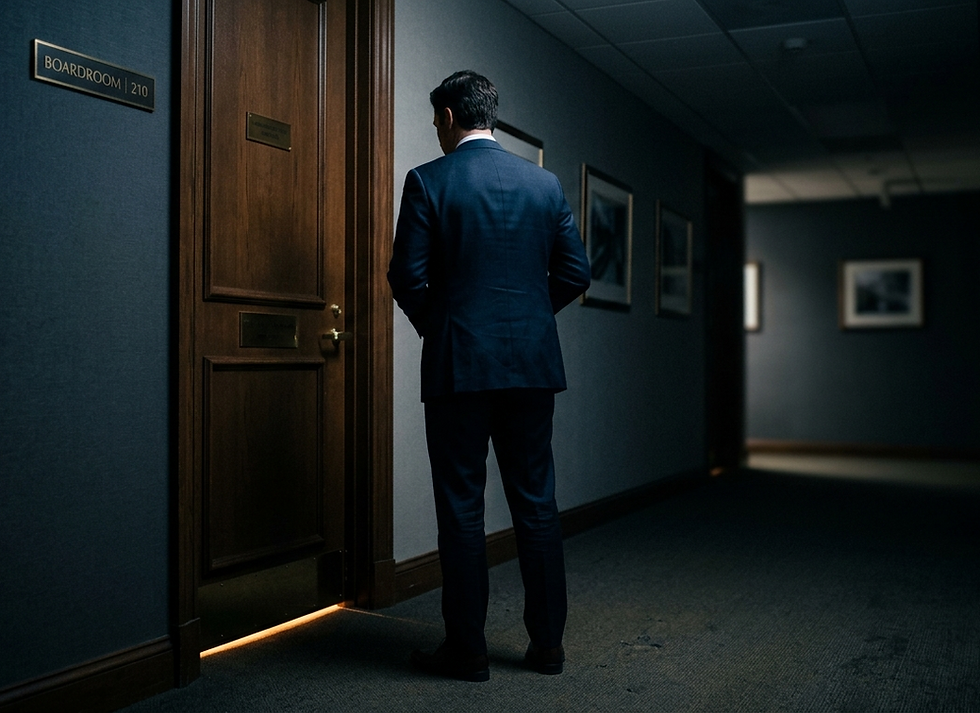
Sahar Andrade, MB.BCh, is a Neuroleadership Coach who works with executives on what pressure does to the nervous system before it shows up in performance. A leader's mood does not stay contained to the person feeling it. It moves upward as well as downward, and the leader watching a boss walk in tense absorbs that shift as fast as a team absorbs a stressed leader. This is nervous system contagion, and it runs in both directions. Once a leader can name the shift the moment it happens, the reaction stops running the rest of the day.
You walk into the building fine. Coffee in hand. Plan for the day already set.
Then you see your boss's face.
Something is off. A clipped hello. A furrowed brow. A door that closes a little harder than usual.
And just like that, your whole day changes.
You do not know what happened yet. You do not know if it involves you. But your body already decided something is wrong, and it is bracing for it.
That is not weakness. That is not overthinking. That is your nervous system doing exactly what it was built to do.
Why does a leader's mood take over the room?
A leader's mood spreads because human brains are wired to read the most powerful person in the room first. This is called mirror neuron activity, and it runs on instinct, not choice.
When someone above you controls your pay, your schedule, or your next promotion, your brain treats their emotional state as critical data. It scans their face before you even say good morning. That scan happens in milliseconds, long before your thinking brain catches up.
Most leadership content talks about this one way. The leader's mood affects the team below them. That is real. But there is a second layer nobody names.
Why does contagion run upward too?
Contagion does not stop at your team. It runs up the chain to you.
You have a boss. Your boss has a mood. That mood becomes data your body reads and reacts to, the same way your team reads yours.
This is the part almost nobody talks about. Leaders are taught to manage their impact on others. Few are taught what happens when they are on the receiving end of someone else's dysregulation.
You can be completely regulated at 8am. By 8:15, after one tense hallway exchange with your boss, your whole nervous system has shifted state. You spend the rest of the morning managing that shift instead of leading your own day.
What does it feel like when contagion runs upward?
It feels like losing hours you never got back.
You replay the tone of your boss's voice. You re-read a two line email for hidden meaning. You walk into your next meeting distracted, still scanning for signs that something is wrong.
None of that shows up on a calendar. None of it looks like work. But it is real cost, and it happens inside your body before you even decide to think about it.
Why can't you just decide to let it go?
Because your nervous system does not take instructions from willpower alone.
The part of the brain that reacts to a boss's sharp tone is faster than the part of the brain that reasons about it. By the time you tell yourself it is probably nothing, your body has already spent energy preparing for a threat that may never come.
This is not a discipline problem. It is a biology problem. And once you can name it as biology, you can start working with it instead of blaming yourself for feeling it.
What can a leader do about it?
Naming it is the first move. When you notice your state shift after contact with your boss, say it plainly to yourself: my body just reacted to someone else's mood, not to a fact about my day.
That single sentence puts a gap between the reaction and your decisions for the rest of the day. It will not erase the reaction. It will stop the reaction from running the whole afternoon.
The deeper work, the kind that actually changes how fast you recover and how much of your day you get back, is not a five minute trick. It is a practice. That is where a room full of leaders doing this work together changes the pace of the recovery.
You are not imagining it. Your boss's mood is real data your body processes every single day, whether anyone ever named it for you or not.
On July 30, a room of leaders is doing exactly this work together, live. Not theory. The actual practice of noticing the shift and getting the day back.
FAQ
Does a boss's mood really affect a leader's nervous system? Yes. The brain reads the emotional state of anyone with power over your outcomes, often before conscious thought catches up. This is not a mindset issue, it is how threat detection works.
Why does upward contagion get less attention than downward contagion? Most leadership content focuses on how a leader's mood affects their team. Few resources address what happens when a leader is on the receiving end of someone else's mood, even though the same nervous system mechanism is at work.
Can a leader train their way out of this reaction? The reaction itself will not disappear completely, since it is wired in. What changes with practice is recovery time, how quickly a leader notices the shift and returns to their own baseline.
Is this the same thing as being too sensitive? No. Reading the emotional state of someone with power over you is an adaptive skill, not a flaw. The problem is not the read. It is not having a way to recover from it quickly.
How long does upward contagion usually last in a day? It varies, but without a recovery practice, the effect of one tense exchange can shape a leader's focus and decisions for hours afterward.
What is the first step to interrupting it? Naming the shift out loud, even silently to yourself, the moment you notice it. That single act creates separation between the reaction and the decisions that follow.
About the Author
Sahar Andrade, MB.BCh, is a Neuroleadership Coach, non-practicing physician, and Forbes Coaches Council member. She helps leaders understand what pressure does to the nervous system, and what to do about it.




Comments